Each day, certain things occur in our lives that brings us happiness or joy. These things usually serve as a counteraction to some of the not so happy moments in our days due to one reason or the other. I believe that as humans, the ability to find a balance between the happy and unhappy things each day adds joy to our lives. Also that if the happy things overwhelmingly exceed the unhappy ones, we're left with a smile either on our faces on in our minds (depending on your personality) at the end of the day.
Well one of such happy things that occured to me today was finding out that my graduation picture was publised in the Afro-American Newspaper.
What is very exciting about this is that I took this picture with some very special people: My mom and dad. Also on the picture are Bernard and Christine who gave their all on that day in helping to make things happen.
Here's a link to the paper containing the above mentioned picture:
http://www.scribd. com/doc/32421344 /Baltimore- Afro-American- Newspaper- June-05-2010
Family is great
A great family is love, peace and happiness
A loving family is home
Home is where the heart is
Your heart is always where those who love you most and dearly are
Above all, God is love!!!
Looking forward happy things in days, weeks, months, years to come; heck looking forward to happiness in the future and sharing this happiness. For sharing is joy.
Thursday, June 17, 2010

Intern year
So on 6/15/10, General Surgery interns at the University of Maryland Medical Center started at their new posts with orientation. We'll be having orientation throughout this week. I've met some really pleasant people and looking forward to working with them!
My dad safely arrived back home, in Cameroon, yesterday after his visit here which was mainly to take part in my Graduation. So blessed to have my parents by my side on graduation day and that'll be forever engraved in my memory. Much thanks to God for the wonderful time spent with dady and his safe arrival back home!!
I also came across this quote at a barber's shop yesterday and found it quite interesting. This was a mischievous man in his 40's who recently bacame a christian, talking to his friends:
- I just found out that God put each and everyone of us on earth to accomplish something or to do something for another person in one way or the other before they die. However, I haven't accomplished anything nor really do anything to help anyone. Oh my ... I will never die. -
Thursday, June 10, 2010
At last!!! Graduated from Medical School

The D-day has finally come and passed... Match day has come and passed. I'll be doing my intern year at the University of Maryland Medical Center as a General Surgery intern. I know that this ain't any easy task but guess what? I'm up to the task.

My parents, neighbors, the surrounding in which I grew up had instilled a quality in me which I truly  thank God for; resilience and hard work.
 thank God for; resilience and hard work.
As a young lad, back in the West African country of Cameroon, I assisted my parents on the farm begining at a very young age. We would go to farm to harvest crops after school and then on weekends, we would go and weed the farm, till soil and do some planting and at the end of a busy day, we will harvest some food crops. Sometimes, dinner will be vegetables harvested from the farm like huckl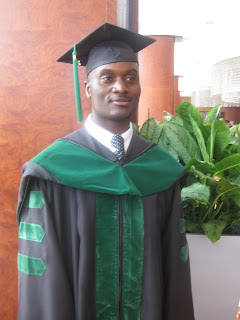 e berry (local name: Njama njama) and cassava roots; or huckle berry and fufu corn (made from flour made out of dried corn). Some evenings, dinner would be boiled fresh corn on the cub and sometimes, we would roast fresh corn and eat with boiled/roasted plums. What this gave me was a sense that I have to work hard in order to get what I need to survive, live and progress in life. That I will fall several times during my journery in pursuit of a better future and to make a difference in my life and those around me. But that it was important to realize that no matter how many times I fall, no matter how bad it hurts, all my struggles and life journey would have gone in vain if I quit. Hence quitting was not an option. Hardwork, resilience and a sense of doing right and making a better future for myself and my fellow men especially those underpriviledged was engraved on my mind at a very early age. How I would make that happen hardly came to mind but I knew I owed that to my self, my parents and the community that allowed me to see the importance of hardwork and team work.
 e berry (local name: Njama njama) and cassava roots; or huckle berry and fufu corn (made from flour made out of dried corn). Some evenings, dinner would be boiled fresh corn on the cub and sometimes, we would roast fresh corn and eat with boiled/roasted plums. What this gave me was a sense that I have to work hard in order to get what I need to survive, live and progress in life. That I will fall several times during my journery in pursuit of a better future and to make a difference in my life and those around me. But that it was important to realize that no matter how many times I fall, no matter how bad it hurts, all my struggles and life journey would have gone in vain if I quit. Hence quitting was not an option. Hardwork, resilience and a sense of doing right and making a better future for myself and my fellow men especially those underpriviledged was engraved on my mind at a very early age. How I would make that happen hardly came to mind but I knew I owed that to my self, my parents and the community that allowed me to see the importance of hardwork and team work.
Being in the US gives me the opportunity to accomplish these things. Atleast, I can work towards giving back. This became quite clear when I entered medical school. Looking back at where I am from, Cameroon, there is a tremendous lack of doctors and worst still, those with a surgical training. I have lived and mingled with various communities in the US and have been volunteering as far back as when I was a Licensed Practical Nurse and in undergraduate and will continue to give back in this manner. However, I will NOT forget to give back in Africa. With my surgical skills and training, there is no doubt that people suffering from various surgical ailments will benefit from my services. It is unfortunate that the Global force on healthcare actually neglects surgical diseases and focus on infectious diseases. Some reasons are that: there is an overwhelming patient population suffering from infectious disease as oppose to surgical diseases, that it costs very much to tackle disease burden due to surgical conditions as oppose to diseases considered public health issues. Recent data however shows that in district hospitals in Africa, the amount of money spent to combat public health illnesses like TB, HIV are quite comparable to what is spent to cater for surgical diseases hence preventing complications associated with these diseases. It is time surgeons press on the issue of the need to ackowledge and carter for the neglected surgical diseases of the developing world. I'm actually writing a paper on this issue and might post it on here when things are final.
I realized I'm been rambling but back to the Graduation.
I owe it to my entire family for being there and supporting me through out med school. Thanks goes to my classmates especially Gerald and Peter with whom we studies for so many hours over many weekends such that if we were to be paid for the time put into our studies then we would be so rich now. Thanks guys for the fun times too!
May 21 was my graduation day and it was a very good feeling walking across the stage, getting my name called and being hooded. I was quite happy to see 2 friends from High school at the commencement ground and I thank them tremendously for their support; Gobo and Leslie ... thank you guys, you're freinds indeed! The graduation party was very nice and great thanks to all those who were there to support me in one way or the other.
Friday, February 19, 2010
But before anything, you must know your patient

The first thing we did in medical school was to study the Human Anatomy. In essence, this was my first patient as a medical student. So even before I had the chance to study about diseases/pathology, their presentation and treatment, I first had to know my patient. This was basically by studying Human Anatomy from cadavers for about 3 months (or was it about 4?). I really honestly enjoyed it. It was really hard work and lots of information. The 24hrs in a day was not nearly enough for me to get all the material I needed to get into my brain. I had to memorize lots of information .... or should I use the fancier word; commit to memory. So as a senior medical student, I really thought that some of the first year students at my school could draw a little bit of inspiration or motivation from my few words. I had been there, done that and I know that I would have appreciated something of that nature as a first year student. (Picture:I am in the blue scrubs in the school's cadaver lab- in my first months of med school)
As a result, I decided to put down some words for the first year students just before their White Coat ceremony. White coat ceremony is the day that first year medical students get their first white coats - it is sort of an initiation into the physician hood. At my school, It is only handed out after successfully completing Human Anatomy course. Therefore in order to have and wear it, you have to earn it by passing that course! Here's what I wrote. It was entitled:
CONGRATULATIONS on earning your first stripe!
CONGRATULATIONS on coming thus far! Remember your interview day at Maryland? Think of the excitement associated with some degree of nervousness and anxiety. Did they really like me? Did I do my best? What would I have done differently? At one point or the other one, or perhaps, all of these thoughts crossed your mind during the interview/ pre-acceptance season. Then you finally got an acceptance from the first public Medical School in the United States. Because you deserved it! Because you are worth it! That spot couldn't be filled by anyone else!
Then came the first day of Med school with the trials and tribulations of Anatomy and Physiology commonly known as A&P which could as well be a code for what it really seems to be at times: Pain in the A**. On that fateful afternoon of August 26 in the year of our lord 2009, you had your first lesson in A&P. For most of you, It was your first for a lot of things: your first patient, first time to wear scrubs, first time to be in such proximity with cadavers, first time to hold a scalpel, first time to cut through human flesh ... and the list goes on. By the end of "Dissection Session 1", the air was filled with the smell of formaldehyde, a smell which never vamoosed and you learn to breath, learn, eat and play with it. Midway through A&P about "Dissection Session 15", being in class by 8A.M and going to cadaver lab thereafter becomes a daily routine. It becomes programmed in to you. By this time, based on your experiences, some of you who have thought about Surgery prior to med school begin to back off. Some of you begin thinking about Surgery as a career (by the way, don't let your A&P experience, nor any other 1st or 2nd yr course, skew your thinking on career choice - there're many more factors down the road. Keep an open mind).
Then came October 30th 2009 when you had your last session, "Dissection Session 29". Over 2 months of A&P experience under your belt. You really feel like you've accomplished something and you truly have. Time to burn those scrubs! or if you're like me, pack them away so that you'll be able to look back some years from now and be like ... those scrubs! It has been a bumpy road, but one worth taking. After all, medical school isn't that easy but not that bad right? But it sure is hard work and dedication; no doubt these are some of the unique qualities that your future patients will expect of you and nothing less. As you traverse this terrain, remember that energy is neither created nor destroyed. This is not only true in Physics/Chemistry; when you put in energy in the form of hard work and dedication you're simply channeling this energy into some other form which you'll see in the form of good results in the case of an exam/test or a happy and grateful patient within the clinical realms. Once more, CONGRATULATIONS on completing the first segment of your marathon. You're warmed up, momentum is up, and you're on your way. You earned your first stripe - a short white coat! Take it with pride, lift your head up and proceed to the next segment. Welcome to Biochemistry!
Job well done future colleagues & Happy White Coat Ceremony!
Remember, the upper class men are at your disposal.
End of writing.
Reflection
My Purpose in Life: A Surgical Vocation
As I count down to match day, I can't help taking myself back a couple of years. My 2006 christmas present was unusual. Something that the giver never intended for it to be christmas present, something you won't think of when you hear of a christmas present. It was an acceptance letter from the University of Maryland School Of Medicine - at that point, I knew that my life's goal of becoming a doctor was finally being realized. A goal which was set up as young as the tender age of 15 when I underwent an appendectomy. I knew that attaining my goal in life was going to allow me to pursue my purpose in life - which I truly believe that, among others, it is serving mankind especially those who are not priviledge to get medical attention whenever they want to. Those who do not have the priviledge of receiving emergency surgical care with no question or money asked upfront; those who might go to the hospital and spend the entire day seating on a bench infront of a surgeon's office yet, unable to be seen and has to come back the following day only if they are able to see the next daylight. Those who are either butchered or killed carelessly on a "surgeon's" operating table because of anesthesia overdose (may Tabezeng Derick RIP) yet, these so called physicians are never held accountable for their action. Those who are at the mercy of physicians who are not specifically trained to be surgeons yet carry out operations after observing and doing few cases. But what can these poor people do? They do not have any choice but to literally adore anyone with the title of a physician who accepts and claims that they could carry out surgery in order to cure them of their ailments. Some of these folks have been diagnosed of cancer but can't afford the very high cost of a surgical oncologist in one of the very few specialized medical centers of the country. How can I not feel for them when I know first hand how miserable I was when I was writhing in pain on that fateful morning when I presented to the hospital with appendicitis. Heck, yes! I would have crawled towards anyone who told me that they were a doctor and could operate on me to cure me. How can I forget those deep in the villages such as Lewoh village who don't even have a medical doctor in their only health care center. A nurse attends to them and prescribes meds for them. Can you imagine someone walking around for years with an umbilical or abdominal wall hernia and has considered it to become an acceptable part of his/herself? I mean, these are not folks who are sedentary, these are folks who would get up as early as 3am and trek by foot for miles upon miles to go do manual labor on their farms - can you imagine how anyone does this with a frank hernia??? the high intra-abdominal pressure during such labor only aggravates it!
This is just a glimpse into the life of my people in Cameroon. The lives of the underserved who are actually the majority of the population; the lives of a people whose healthcare system is really set up to serve the very rich and those who can easily afford healthcare while those who can not pay before any treatment, including most emergencies, are doomed to suffer! Where the common man hardly ever has access to well trained General or sub-specialized surgeons.
As an example, the World Health Orgnanization (WHO) had the five leading cause of death projected for 2005 as
1-Communicable, maternal, perinatal, nutritional conditions: # of deaths --> 154,870
2-Cardiovascular diseases: # of deaths -->31,180
3-Other Chronic Diseases: # of deaths -->21,539
4-Injuries: # of deaths -->16,885
5-Malignant neoplasms: # of deaths --> 12,259
and the projection for 2030 as follows:
1-Communicable, maternal, perinatal, nutritional conditions: # of deaths --> 164,278
2-Cardiovascular diseases: # of deaths -->47,106
3-Other Chronic Diseases: # of deaths -->32,643
4-Injuries: # of deaths --> 25,644
5- Malignant neoplasms: # of deaths --> 22,023
Check out the original stats: https://apps.who.int/infobase/report.aspx?rid=153&iso=CMR&generateResults=Generate+Report
I'll focus on malignancy (b/c it's an area of interest to me). It is the 5th leading cause of death and by 2030, deaths would have increased by a staggering 80%. Implication: Those people who can be saved by surgery w/ a combination of chemo should be saved. Only if some of these poor patients had access to surgical oncologist, the situation will mostly likely be different. Primary care is surely an issue but not much of an issue as surgical. With my surgical training, I plan on having an impact together with some of my colleagues. By the way, I think a missionary organization The Pan-African Academy of Christian Surgeons (PAACS) is doing a wonderful job in training African doctors to become surgeons.
So this sheds some light as to why that acceptance into med school was a special but unusual Christmas gift. That which money couldn't buy.
Student Loans - Financial slavery?
This is an interesting article which I first saw circulating on the popular site studentdoctor.net and then on a yahoo e-group. Lesson of the day is that you can be enslaved by student loans if you don't manage them responsibly. http://finance.yahoo.com/college-education/article/108846/the-555000-student-loan-burden?mod=edu-continuing_education.
I think this reflects a common theme going on with graduates of higher education. Dr. Bisutti's case is a very good example that there are times when the only option is to take out loans in exchange for a higher education. This is particularly true in the U.S where higher education (professional schools in particular) is very expensive. The cost for undergraduate education is quickly on the rise as well. However, in order to stay out of financial horrors as in this report, it is very important to make a plan on how to start repaying these loans. Pushing them off by the side is not an option b/c the burden will only come back and bite you. A misconception that people have, including some medical students, is that once medical students become MDs they'll be able to pay off these loans easily AND live a lavish life style. Well, not always true. One of the determining factors is the specialty you chose. For instance, Dr. Bisutti decided to go into Family Medicine which is one of the least paid medical specialties with an average annual income of about $135,000. Given that she has med school related loans of about $250,000 and that she makes monthly payments, she will be able to live like someone within the middle income range i.e comfortable and NOTHING MORE than that. It all boils down to being responsible in managing your loans.
Nowadays, more medical students are making the decision not to go into primary care i.e Family Practice, General internal medicine partly because of the above situation. With time, patients will be affected most b/c these primary care physicians are your front line doctors. The every day guys you see for your every day ailments. They are the ones will usually take care of your common complaints like...."I've been having this headache for a while and my body aches all over and I've been feeling really tired" and then they refer you to specialist, if need be. So with a decrease in primary care physicians, this means longer wait times to get an appointment; increase in patient load per doc which implies longer wait times in doctor's office when you do get an appointment and a likely decrease in those volunteering their time in free clinics for those uninsured. This's a lesson to be learned b/c even a $29,000 undergraduate loan can quickly spiral up to $90,000 if not managed appropriately, as in the report.
Thursday, February 18, 2010
RESILIENCE ... how far can it get us?
Hi folks, so I was listening to a speech made by Virginia congressman and he stated part of the quote below. The quote was what was originally said by the 30th president of the U.S, President Calvin Coolidge. Why does this quote sounds so deep to me, gets me all fired up and excited? Because even without haven't seen it before, that's what my motto in life basically is:
Work hard, be resilient and critical.
and yes, it has worked for me even when, at times, it seems like there's a road block, an unbreakable wall, a steep and topless mountain ... this motto always knocks it down and gets me going. Yes, not without struggles, sweat and the thought of uncertainties but my eye is always on the "price" - the end product.
So here's the quote:
"Nothing in the world can take the place of Persistence. Talent will not; nothing is more common than unsuccessful men with talent. Genius will not; unrewarded genius is almost a proverb. Education will not; the world is full of educated derelicts. Persistence and determination alone are omnipotent. The slogan 'Press On' has solved and always will solve the problems of the human race."
Calvin Coolidge 30th president of US (1872 - 1933)
Here's another quote which is inspiring to me:
"Let me tell you the secret that has led me to my goal: my strength lies solely in my tenacity."
Louis Pasteur who was a microbiologist, discovered first vaccine for rabies and best known by the general public for pasteurization.
Subscribe to:
Posts (Atom)
